
The Day Empire Tycoon Made Its First Dollar
Ten months of building. Two kids on the couch. Months of crickets. Then on February 5, a stranger paid $4.99. This is what that one sale actually meant.
April 2025. My kids and I were playing AdVenture Capitalist on the couch, taking turns smashing the income button. One of them looked up and said, "We should make one of these."
I don't know exactly what made me take it seriously — maybe just that they kept asking — but a week later there was a Flutter project on the iPad, three businesses, a manual upgrade button, and the world's ugliest tap-to-earn loop. That was the start of Empire Tycoon. Not a product. Something to build with my sons.
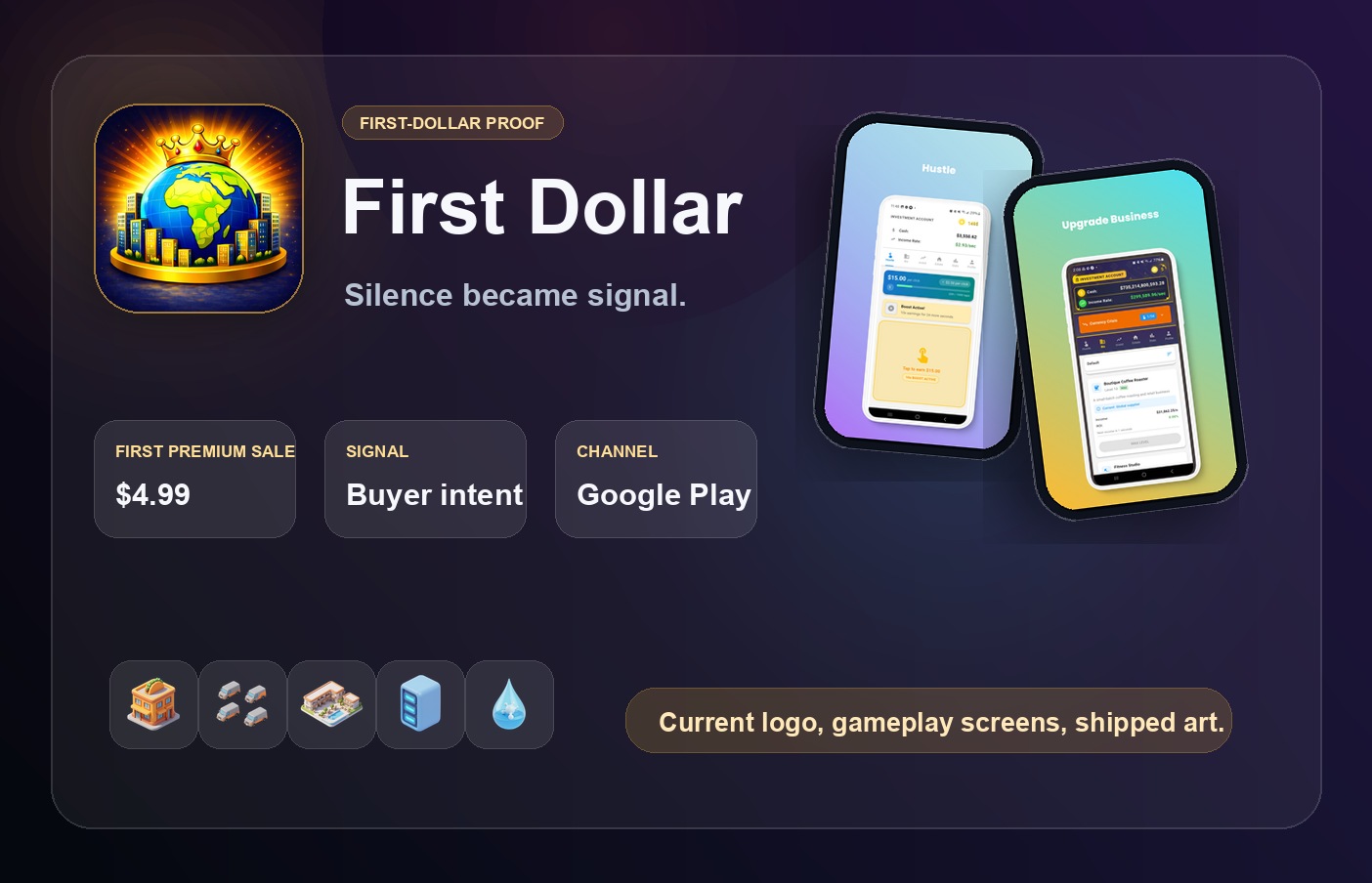
Current Empire Tycoon logo, existing game art, and gameplay screenshots: the same project that later produced the first paid purchase.
The first buyer did not matter because of the amount. The first buyer mattered because the silence stopped being the answer.
A stranger reached the top of the IAP shelf, picked premium, and paid for the game without knowing the studio. That one event turned the build from a family side project into a measurable product.
What the first sale proved
The loop had pull
A player stayed long enough to open the IAP carousel and choose the long-tail unlock.
The shelf had a winner
The first purchase went to the dominant premium offer, not the cheapest SKU.
Placement mattered
The post-build prompt converted before the prestige-screen prompt did.
Silence was incomplete data
Months of quiet were not proof that nobody would pay.
The build, on the couch
We worked on it on weekends. They'd play whatever I'd shipped that morning, then come back with notes. The notes were almost always about feel. "It's not satisfying when you upgrade." "The numbers are too small." "Why does the manager just disappear when you tap him?" They didn't know the language for game design but they knew when something was off, and they had infinite patience for me iterating in front of them.
By the summer the gameloop was real. Eleven businesses, a working prestige system, hustle taps that did something, a property layer that felt good to expand. The investment system came from one of them asking why you couldn't park money somewhere instead of only spending it. I'd been hesitating on that for weeks. His question made the answer obvious. I prototyped it that afternoon.
We launched on Google Play in late 2025. Quietly. No marketing. The boys were the first installers. I took a screenshot of the first 1.0 release and texted it to my brother.
Then nothing happened, for months
The Play Store has a way of telling you that nobody cares. Daily installs in the single digits. Most of those were probably my own test devices and the boys' Chromebooks. AdMob earnings hovered between zero and twenty-nine cents per day. The eCPM dashboard was technically reporting numbers, but they were the kind of numbers that round to nothing happened today.
Every week I'd ship a small fix or a new business or polish a transition, push the build, watch the stats, and see exactly the same thing. Occasionally a stranger would file a comment — usually someone reporting a crash on a phone I'd never tested on — and it would feel like contact from another planet. Then back to silence.
I'd started this for the kids and I was still doing it for the kids and that was supposed to be enough. Some days it was. Other days I'd open the analytics dashboard at 11pm and feel a kind of bone-tiredness that's hard to describe. You build something, you keep building it, and the world doesn't notice.
February 2026 — the $600 challenge
By February 1 of this year — ten months in — the game was live and good and quiet. I gave myself a thirty-day window to recoup $600 in real revenue, mostly to force myself to stop hiding behind "still polishing" and start shipping some marketing. Most days I missed the daily target by a factor of ten. Some days fifty.
Then on Day 5, this line appeared in the scoreboard:
2026-02-05 premium_sale $4.99 Manual report from Steve
That's the whole artifact. Five dollars from a stranger, recorded by hand because I hadn't yet wired up the BigQuery sync. The SKU was premium_purchase — $4.99, remove ads plus 1,500 platinum points. The most expensive thing on the shelf.
What that one sale actually meant
A real human, somewhere in the world, had downloaded the game, played enough of it to want more, opened the IAP carousel, picked an option, and paid for premium content. None of those events were inevitable. The download wasn't inevitable. The play session wasn't inevitable. The decision to even open the IAP screen wasn't inevitable. And the decision to spend money on a game shipped by a one-person studio they'd never heard of, that was the least inevitable of all.
I sat with that for a minute. Ten months of building. Hundreds of small decisions about feel and progression and the right size of a number on a button. Weekend playtests with my kids. Quiet weeks where I assumed nobody was out there. And somebody had finally said, with their wallet, "this is worth four ninety-nine to me."
That meant something. It still does.
The data, after the goosebumps wore off
The buyer reached for the top of the shelf. That's information.
Empire Tycoon's IAP catalog, straight from BillingService:
| SKU | Price | What it does |
|---|---|---|
pp_pack_small | $0.99 | 100 platinum points |
income_boost_24h | $1.99 | 2× income for 24 hours |
pp_pack_medium | $2.49 | 500 platinum points |
starter_bundle | $2.99 | 200 PP + 2× income for 24h |
pp_pack_large | $4.99 | 1,500 platinum points |
premium_purchase | $4.99 | Remove ads + 1,500 platinum points |
Two SKUs tie for the top at $4.99. One of them — premium_purchase — strictly dominates: the same 1,500 platinum points as pp_pack_large, plus permanent ad-removal, at no extra cost. So at the top of the shelf there's a cheaper-or-equal item that just gives you more. The first buyer skipped past the ninety-nine-cent pack and the dollar boost and the starter bundle and went straight to the dominant offer.
Why?
Because removing ads from an idle game is the IAP that earns its keep over the long tail of the session. Income boosts wear off. Platinum packs get spent. Ad removal compounds every minute you keep playing. The buyer wasn't tire-kicking. They had been playing long enough to know they wanted to keep playing, and they picked the unlock that paid back forever. That's a much more committed read on the IAP carousel than I'd given a first-session player credit for.
By Day 90 the buyer count was up into the dozens. The premium ad-removal tier carried the bulk of the gross — about half the buyers, well over half the dollars. The dollar packs and income boosts trailed, mostly bought by players who'd already been playing long enough to know they wanted more platinum points, faster. The pattern held: most of the people who paid, paid for the same thing the first stranger had picked.
The first buyer wasn't an outlier. They were the first proof of a pattern that's still playing out.
NOTE
Gross figures come from BigQuery's event_value_in_usd, which includes regional pricing variation, so the per-buyer totals don't always match clean per-unit math. The unit prices in the SKU table are the US display prices.
The one thing I changed the next day
The IAP prompt had been firing on the prestige screen — once a player completed their first reset. The first buyer never prestiged. They saw the carousel because I'd also planted the prompt on the post-build summary screen, almost as an afterthought. That afterthought was where the conversion actually happened.
So on Day 6 I moved the post-build placement earlier in the loop, made it the primary, and pushed the prestige-screen prompt to secondary. Buyer activation jumped on the change. The same shelf has been carrying buyers ever since.
What I think about now
I don't think much about the first dollar in dollar terms anymore. $4.99 is a rounding error against a year of nights and weekends.
What I think about is what the first dollar broke open: the assumption that nobody was out there.
There were people out there. They were busy, they were skeptical, the Play Store algorithm wasn't surfacing the game, the icon wasn't quite right yet, and some percentage of them were going to install Empire Tycoon, play through the first hour, and quietly decide it was worth $4.99 to keep going without ads. That percentage is small. It's not zero.
If you've shipped something and watched it land in silence, the only honest thing I can tell you is: the silence is not the answer. The silence is the absence of the answer. The answer comes from the one stranger who plays through and pays.
You only need one to know.
Empire Tycoon is still my side project. The boys still ship me notes. The strangers in the data keep arriving. Some weeks that feels like nothing. Most weeks, ten months in, it feels like a lot.
Play Empire Tycoon
The idle-game side of Go7Studio — eleven businesses, prestige loops, real estate, hustle taps. Free, ad-supported, on iOS and Android.
Download Empire Tycoon