
We Shipped 4 Games with AI in 30 Days — Here's How
A small studio used AI-assisted production lanes to build, ship, and monetize four games across Flutter, Unity, and Roblox in a single month. Real numbers, real code, real lessons.
Most game studios spend months on a single title. We shipped four — across three different engines — in 30 days. Not prototypes. Published, monetized games with real users generating real revenue.
The secret wasn't crunch. It was three AI-assisted production lanes working alongside a solo developer: engineering, product strategy, and review.
Here's exactly how we did it, what went wrong, and whether we'd do it again.
The multiplier was not AI replacing the developer. It was role separation around the repeatable work.
The workflow handled scaffolding, integrations, documentation, analytics, and batch tasks. The human kept the parts that still need taste: game feel, platform judgment, final art direction, and whether the shipped loop was worth playing.
What survived the sprint
Clear production lanes
Strategy, engineering, and review stayed separate enough that parallel work remained usable.
Fast feedback loops
Flutter moved fastest because builds, state, and UI feedback made iteration cheap.
Human taste stayed central
Economy balance, feel, and final product judgment did not become automated.
Reusable systems compounded
Ad integration, analytics, asset workflows, and deployment scripts carried into the next games.
The Challenge: $600 in 30 Days
The rules were simple: starting from zero, generate $600 in revenue across new games within 30 days. No existing audience. No marketing budget. Just code, creativity, and AI.
Why $600? It's not life-changing money — that's the point. It's proof of concept. Can a tiny team with AI tools ship real products fast enough to generate real revenue? Not "revenue" from a hackathon pitch deck. Actual dollars from actual players.
The Tech Stack
Every game shared a core philosophy: ship fast, iterate based on data, let AI handle the repetitive work.
| Game | Engine | Platform | Dev Time |
|---|---|---|---|
| Stakd | Flutter | Android | ~3 days |
| Empire Tycoon | Flutter | Android | ~7 days |
| Rampart | Unity | Android | ~7 days |
| SlimeSlip | Roblox Studio | Roblox | ~4 days |
The AI-assisted workflow was not just autocomplete. Each lane had a distinct role:
- Strategy lane — Content creation, marketing, analytics, and coordination across all projects
- Engineering lane — Code architecture, infrastructure, CI/CD, performance optimization, and debugging
- Research lane — SEO review, market research, user experience auditing, and content QA
The system worked because the responsibilities were separated cleanly across codebases, deployment pipelines, analytics dashboards, and review steps.
Game 1: Stakd — The Puzzle Warmup (3 Days)
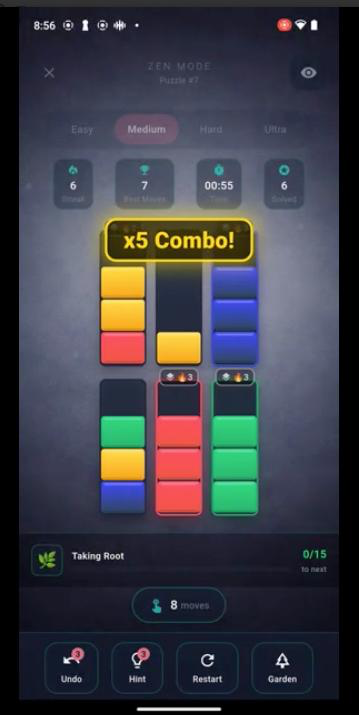
Stakd is a spatial puzzle game where players stack blocks to fill patterns. Think Tetris meets jigsaw, with a zen garden reward system.
What AI did:
- Generated the initial game architecture and state management
- Designed the difficulty curve algorithm (adaptive based on player performance)
- Created all zen garden visual assets via Stable Diffusion
- Wrote the AdMob integration and handled the monetization flow
What the human did:
- Core game feel — the "juice" of how blocks snap and stack
- Final art direction decisions
- Play Store listing and screenshots
- Quality control on the overall experience
Key lesson: AI is excellent at boilerplate and systems (ad integration, state management, save/load). It struggles with game feel — the micro-interactions that make a game satisfying to play.
Result: Live on Play Store within 72 hours of first commit.
Game 2: Empire Tycoon — The Revenue Engine (7 Days)
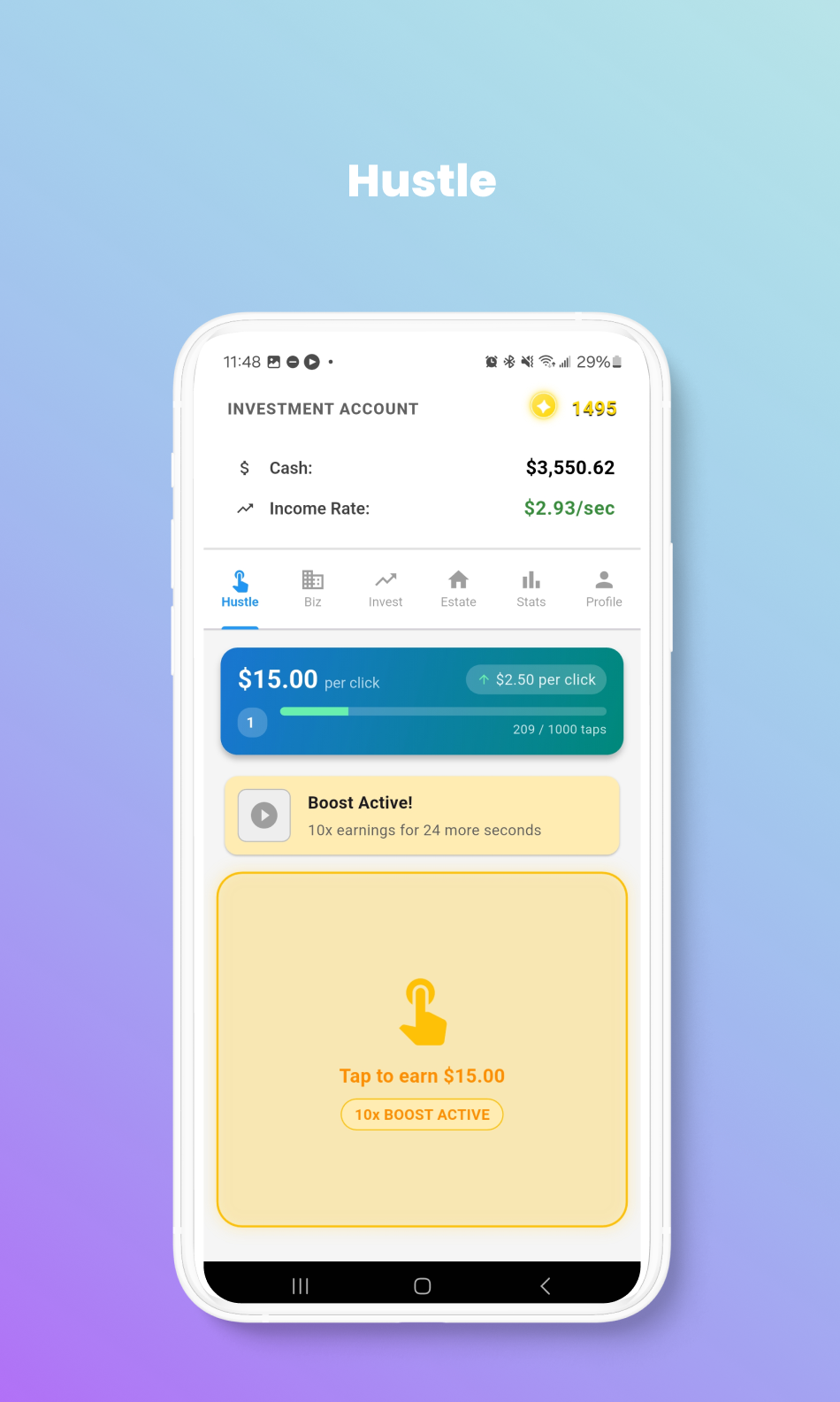
Empire Tycoon became the flagship. An idle/tycoon game where players build a business empire from a single lemonade stand to a global conglomerate with real estate, stock markets, and prestige reincorporation.
This is where the AI-human collaboration really clicked.
Architecture (AI-driven):
- Full economy model with inflation curves, business tier progressions, and investment simulations
- Offline income calculation with anti-cheat mechanisms
- Cloud-synced leaderboards with percentile rankings
- AdMob integration with rewarded ads for boost mechanics (10x earnings, 2x offline income)
- Premium currency system (Platinum Points) with careful free-to-play economy balance
Content (AI-generated, human-curated):
- 11 business types with unique upgrade trees
- 20 real estate locations across 5 tiers (Rural Kenya → Dubai)
- Stock market with 15+ fictional companies across sectors
- Achievement system with 58 milestones
- Creator code system for influencer partnerships
What took the most time: Economy balancing. The AI could generate progression curves, but tuning them so the game felt right — not too fast, not too grindy — required dozens of human play sessions.
Revenue model:
- Rewarded video ads (primary — 10x Hustle Boost, 2x Offline Income)
- In-app purchases (Platinum Points, Premium subscription)
- No paywalls — everything earnable through gameplay
Result: 190+ daily active users, $250+ revenue in first month, 4.2★ rating.
Game 3: Rampart — Wave Defense in Unity (7 Days)
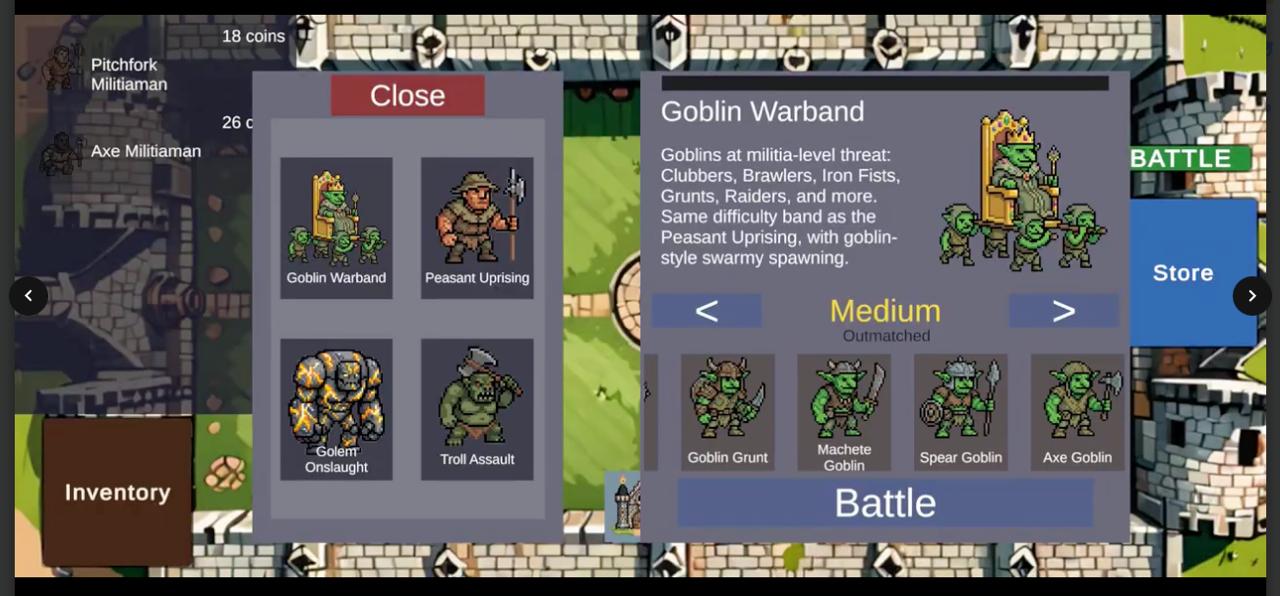
Rampart (working title: Idle Attack) is a wave defense game built in Unity. Players deploy troops — militiamen, goblins, trolls, golems — to defend against increasingly difficult enemy waves.
This was the AI-assisted production stress test: could the workflow move effectively in Unity/C#?
What worked:
- The engineering lane handled the entire build pipeline (IL2CPP compilation, Android keystore signing, AAB generation)
- AI-generated prefab configurations for 40+ unique troop types
- Automated sprite sheet processing and background removal
- Battle stat tracking and UI panel generation
What didn't:
- Unity's component architecture is harder for AI to reason about than Flutter's widget tree
- Prefab references and
Resources.Load()paths broke frequently - The AI would fix one script and introduce regressions in another
Key lesson: AI works best in frameworks with strong conventions and fast feedback loops. Flutter's hot reload + widget paradigm = ideal for AI. Unity's editor-heavy workflow = more friction.
Result: Playable APK on Google Drive, 40+ troop types, active development with a human collaborator (Liam).
Game 4: SlimeSlip — Roblox in 4 Days
SlimeSlip targeted a completely different market: Roblox's 70M+ daily active users. It's an obby (obstacle course) game with slime physics.
AI contribution:
- Generated the Lua game scripts and obstacle configurations
- Handled Roblox-specific patterns (DataStores, RemoteEvents)
- Created marketing materials and game description copy
The Roblox reality check: The platform has its own ecosystem, economy, and discovery mechanics. Getting traction requires understanding Roblox culture — something AI can research but can't feel.
Result: Published on Roblox, providing a foothold in the platform for future development.
The AI Agent Workflow
Here's what a typical day looked like during the sprint:
Morning (Human + AI Planning)
- Review overnight analytics (AI-pulled from AdMob, GA4, Play Console)
- Prioritize bugs vs features vs content
- Split work across production lanes
Daytime (Parallel Execution)
- Engineering pushes code changes, runs builds, and deploys
- Strategy creates marketing content, analyzes user behavior, and writes copy
- Research/QA audits UX, researches competitors, and reviews content for SEO
- Human plays the games, makes design decisions, approves external communications
Evening / Overnight
- AI-assisted tooling runs batch tasks: asset generation, analytics collection, QA checklist generation
- Automated backups to NAS
- Morning handoff report ready by 6 AM
The multiplier effect: A solo developer with a disciplined AI-assisted workflow is not a magic 4x multiplier. It is closer to 2-3x on raw output. But the type of work changes dramatically. The human stops writing boilerplate and starts making higher-level decisions. That's where the real leverage is.
What AI Does Well in Game Dev
- Boilerplate and scaffolding — Setting up project structure, adding integrations (ads, analytics, auth), writing CRUD operations
- Iteration at speed — Need to test 5 different economy curves? AI generates all 5 while you review the first
- Cross-domain work — The same workflow spans Dart, C#, Lua, JavaScript, Python, and shell scripts
- Documentation — Every decision, every architecture choice, every bug fix gets documented automatically
- 24/7 availability — Overnight batch processing, monitoring, asset generation while you sleep
What AI Can't Do (Yet)
- Game feel — The satisfying snap of a block placement, the weight of a character landing. This is intuitive, embodied knowledge that AI doesn't have
- Taste — AI generates options. Humans pick the good ones. Without curation, AI output is mediocre
- Player empathy — Understanding why a player churns at level 7 requires human intuition about frustration and reward
- Platform culture — Each platform (Play Store, Roblox, App Store) has unwritten rules. AI can learn them from data, but slowly
- Creative direction — AI is a powerful instrument. Someone still needs to be the composer
The Numbers
Let's talk real results after 30 days:
- 4 games shipped across 3 engines and 2 platforms
- 190+ DAU on Empire Tycoon (organic, no paid acquisition)
- $250+ revenue (AdMob + IAP combined)
- 50+ videos produced for YouTube marketing
- ~55-60 new installs/day (organic Play Store)
Is $250 in 30 days going to retire anyone? No. But consider:
- Zero marketing spend
- Solo developer + AI
- Games generating recurring revenue that compounds with content updates
- Reusable systems (ad integration, analytics, deployment pipelines) that accelerate future games
Would We Do It Again?
Yes — but differently.
What we'd keep:
- Multi-lane workflow with clear role separation
- Ship-first mentality (perfect is the enemy of live)
- Flutter as primary engine for mobile (speed advantage is real)
- Automated pipelines for everything repeatable
What we'd change:
- Start with one game and go deeper (Empire Tycoon alone could have hit $600 with more focused marketing)
- Invest more in ASO from day one
- Build the blog and SEO infrastructure earlier (you're reading the result of that lesson)
- Use AI for user acquisition experiments, not just development
What's Next
We're continuing to develop all four games, with Empire Tycoon as the primary focus. The production workflow now supports:
- Automated art generation via Stable Diffusion with custom-trained LoRA models
- SEO and content marketing (this blog post is part of that strategy)
- Business expansion systems — 11 businesses with 4 upgrade variants each
- Real estate manager characters for 20 global locations
The $600 challenge taught us that AI doesn't replace game developers — it removes the bottlenecks that keep solo developers from shipping. And shipping is everything.
Go7Studio builds mobile games with AI-assisted development workflows. Our games include Empire Tycoon, Stakd, Rampart, and SlimeSlip. Interested in how we work? Get in touch.